Is A Free Walking Tour Really Free?
How pay-what-you-want walking tours actually work in Sydney, what the guides earn, and where the money really goes.
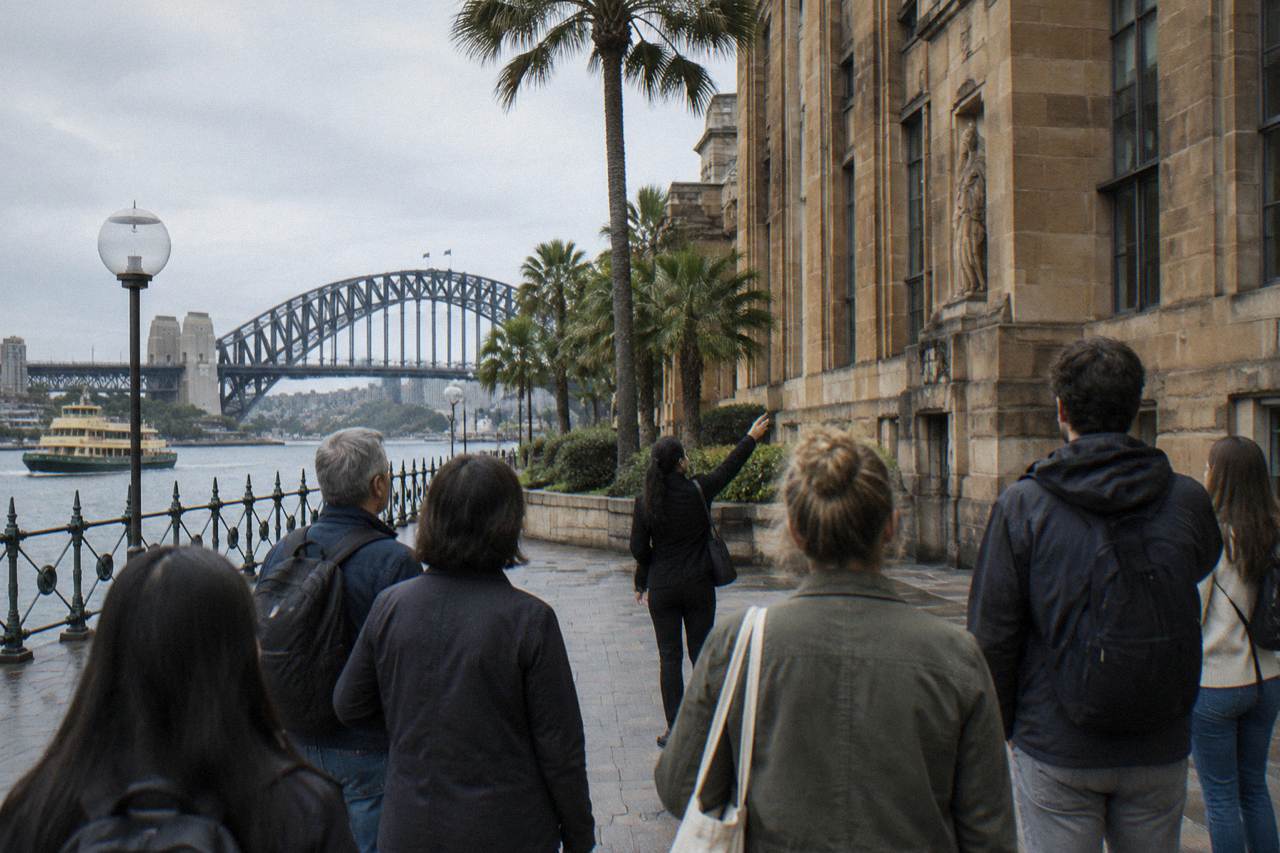
A guide stands at Wharf 6 at Circular Quay holding a sign, and twenty strangers who paid nothing to be there are about to follow them for two and a half hours through the oldest streets in Sydney. Nobody has swiped a card. Nobody has been charged a deposit. At the end of the walk, each person will reach into a pocket and hand over whatever they think the experience was worth, or nothing at all. That is the entire business model, and it holds up better under scrutiny than it first appears. The question of whether such a tour is "really" free has a genuinely split answer, and it depends entirely on which of three people you ask: the walker, the guide, or the platform in the middle. This site lists five pay-what-you-want walks in Sydney, two listed on GuruWalk and three exclusive to freetour.com, and three of those carry a card here. Every one of them operates on the same honour-system economics, and every one of them is a real listing run by an independent local guide rather than by this site, which operates nothing and takes no booking.
Is A Free Walking Tour Really Free?
Yes in the strict sense, and no in the economic sense: a free walking tour costs nothing to book and nothing to walk, but it is a business, and the guide's income is the tip you choose to give at the end. That is the honest, complete answer, and it is worth unpacking carefully because the unpacking changes how a walker should behave on one.
Start with the strict sense, because it is the one that matters to a budget. Booking a free walking tour costs no money. There is no ticket price, no deposit, no minimum spend, and no hidden fee charged at the end. The three featured walks on this site are all listed this way: Best Free Tours Sydney on GuruWalk, the Sydney Sunset Evening Tour on GuruWalk, and the Sydney Rocks Free Tour on freetour.com. A walker reserves a spot, shows up at the meeting point, walks the route, and then decides what, if anything, to hand over. If a walker genuinely has nothing, they can walk the whole route and give nothing, and no one will stop them or bill them. In that narrow, literal sense the tour is free in a way that almost nothing else in a visitor economy is.
Now the economic sense. The tour is not free to produce. A guide spends two to three hours of trained labour, pays their own transport to the meeting point, maintains liability insurance in most operating models, markets the walk, researches the route, and absorbs the risk that a rainy Tuesday produces four walkers and fifteen no-shows. The money that pays for all of that comes from tips, and tips only. The pay-what-you-want model is not charity, it is price discrimination turned inside out: instead of the seller setting one price and losing every customer who would have paid less, the seller lets each customer set their own price and captures something from everyone, including the customers who would never have booked at a fixed price at all. A walker who would have balked at a $40 fixed ticket shows up for free, enjoys the walk, and hands over $25 they were never obliged to give. The model works precisely because the obligation is removed.
It also works because of social pressure, and it is dishonest to pretend otherwise. Standing at the front of a group at the end of a two-hour walk, having learned the guide's name and heard a story about their grandmother arriving from Naples, the average person finds it socially near-impossible to walk away without contributing. The model converts a transaction into a relationship and then lets the relationship do the pricing. That is not a scam. The guide genuinely performed the service, the walker genuinely received it, and the tip genuinely reflects the walker's own valuation. But a walker who understands the mechanics tips better, because they understand that the "free" walk is the guide's entire livelihood, not a loss leader subsidised by an invisible corporation.
There is a second layer worth naming, because this site is honest about its own economics too. Platforms like GuruWalk and freetour.com list these walks, handle reservations, host reviews, and in most operating models take a commission or a booking-service margin on what walkers pay or on flat guide fees. This site is a directory that points at those listings, carries no walk of its own, and is not affiliated with GuruWalk or freetour.com. When a reader reserves a free spot through a walk's page here, the reservation happens on GuruWalk or freetour.com, the walk is run by an independent local guide, and any money that changes hands at the end of the walk goes from the walker's hand to the guide's pocket, minus whatever the platform's published terms say it takes. Nothing about that chain is hidden, and nothing about it makes the walk less free to the walker standing at the meeting point.
So the answer, stated one more time with the qualifiers attached: a free walking tour is free to book, free to walk, and free to leave without paying, but it is not free to run, and the guide's wage is set entirely by what the walkers decide it should be. A fair walker treats "free" as meaning "I set the price afterwards", and prices honestly.
The comparison with fixed-price tourism is instructive. A paid guided tour in Sydney typically runs somewhere between $40 and $100 per adult for a comparable length of walk, and the walker pays that before knowing whether the guide is any good. The pay-what-you-want model reverses the information problem: the walker pays after the quality has been fully revealed, which means the guide carries all the risk and the walker carries none. This is why free walking tours attract walkers who are not even budget travellers, and why the guides who survive on the model tend to be unusually good. A mediocre guide can survive on prepaid tickets and a cancellation policy. A pay-what-you-want guide lives or dies on the last five minutes of every single walk, when the envelope comes out. The strongest walks on this site reflect that pressure in their numbers: the Sydney Sunset Evening Tour holds 4.96 out of 5 on GuruWalk from 51 reviews, and the Sydney Rocks Free Tour holds 9.5 out of 10 on freetour.com from 43 reviews. Those are not the numbers of guides coasting on a guaranteed ticket price.
There is a final, practical sense in which the tour is free that deserves its own sentence: it costs no money to cancel or no-show, because there was no money to refund. A walker who books a paid tour and sleeps through the alarm loses the fare. A walker who books a free tour and sleeps through the alarm loses nothing except the walk itself. For a traveller building a loose itinerary, that asymmetry makes free walks the natural backbone of a plan: they can be reserved generously, dropped without penalty, and rebooked for another day.
How much should a walker actually tip, then? There is no published figure for Sydney's walks, and this site will not invent one. What can be said honestly is the structure of the decision: the tip should reflect what the walk was worth relative to what a fixed-price tour of the same quality would have cost, adjusted for the walker's own budget. A walker who valued the walk at the level of a $60 paid tour but can only afford $20 should give $20 without shame, because the model is designed to accept exactly that. A walker who can afford full value and gives a token amount is not beating the system, they are simply shifting the cost of the walk onto the other people in the group who paid honestly. The guide's income for the afternoon is the sum of the envelope, and the model only keeps producing good guides if that sum keeps being worth the labour.
The group itself is part of what a walker is paying for, which is a point the "is it really free" framing usually misses. A walking tour is not just information delivered at walking pace. It is twenty strangers from six countries who now share a story about a convict-built wall, a route walked together, and a guide whose job is partly to make a temporary small society out of a crowd. That social layer is why the model tips well in practice and why it has spread to essentially every major tourism city in the world. Sydney's five pay-what-you-want walks sit inside a global tradition that has proven the economics for over two decades.
Barangaroo Reserve makes a good case study in what a walking route actually delivers, because it is one of the few Sydney sites where the "free" claim survives every test. The reserve is a free public park on the western harbour edge, built over reworked industrial land and named for the Gadigal woman Barangaroo, and it costs nothing to enter at any hour it is open. A walking route that threads the harbour edge can pass through it and add a genuinely free attraction to the day's ledger: the sandstone foreshore blocks, the native planting, the harbour views across to Balmain and the bridge. The one honest caveat for the current season is that Marrinawi Cove, the swimming cove inside the reserve, is mid-upgrade with localised fencing in place since mid-September 2026, targeted for completion before summer, so the reserve overall stays open but the cove area carries disruption. That does not change the price of anything, which is the point: a free park with works underway is still a free park, and a walker who passes through it on a pay-what-you-want route is stacking two genuinely free experiences on top of each other.
Customs House, a short walk up from Circular Quay, shows the other side of the route economics: what happens when a "free" claim sits on moderate-confidence ground. The building's ground floor houses a public library, and the site is widely described as free to enter, with a well-known scale model of the city inside that walking routes often stop at. This site's research pass flagged the Customs House free claim as moderate confidence only, sourced to the venue's general site rather than a confirmed current visit page, so it is recorded here with that qualifier attached rather than as a flat fact. The honest way to treat it on a walk is as a likely-free stop worth a look if the door is open, not a guaranteed free attraction to plan around. That distinction matters for exactly the question this article asks: a walker who assumes every stop on a free route is itself a free attraction can arrive somewhere and find the assumption wrong, and the difference between "free" and "probably free" is the difference between a plan that holds and one that quietly fails.
The Museum of Contemporary Art Australia is the sharpest possible illustration of why the "is it free" question deserves constant re-checking, because it is the one major Sydney venue where the answer recently flipped. The MCA had free general admission for decades, and an enormous amount of existing travel content still says so, including content published years after the change. A Sydney Morning Herald report dated 2 May 2026 confirms the MCA reintroduced paid general admission in 2025, at AUD $20 adult. This site records the MCA as paid, not free, This is now confirmed directly on the museum’s own tickets page at mca.com.au, not just from news coverage. The lesson for the free-tour question is direct: "free" is not a permanent property of a building, it is a current policy, and policies change without the building changing. A walker who read a 2019 guidebook and budgeted a free MCA afternoon in 2026 has been misled by stale data, not by the museum. The same discipline applies to walking tours themselves, which is why this site states each walk's rating, scale, and review count from its live platform listing rather than from memory.
For practical reference, the table below sets out the five pay-what-you-want walks this site carries, with their platform, rating, scale, review count, and meeting point, alongside two of the genuinely free attractions a Sydney route can thread together. The two freetour.com exclusives beyond the Rocks walk, the Essential Tour Part One and Part Two, have their own pages on this site but no card, which is why they appear in the roster but not in the card block above.
| Walk / Attraction | Platform | Rating | Scale | Reviews | Meeting Point / Location |
|---|---|---|---|---|---|
| Best Free Tours Sydney | GuruWalk (53905) | 4.55 EN / 4.86 ES | out of 5 | 384 total | Wharf 6, Circular Quay |
| Sydney Sunset Evening Tour | GuruWalk (67793) | 4.96 | out of 5 | 51 | Queen Victoria Building, George Street |
| Sydney Rocks Free Tour | freetour.com | 9.5 | out of 10 | 43 | The Rocks, Sydney |
| Sydney Essential Tour Part One | freetour.com | 7.2 | out of 10 | 24 | Jacksons on George |
| Sydney Essential Tour Part Two | freetour.com | 7.1 | out of 10 | 6 | Royal Botanic Garden area (monument meeting point) |
| Royal Botanic Garden Sydney | Free public attraction | Free general entry | 7am-sunset | n/a | Farm Cove, Sydney |
| Bondi To Coogee Coastal Walk | Free public path | Free | n/a | n/a | Bondi Beach, Sydney |
Free Things To Do In Sydney Nearby
A walker who has absorbed the pay-what-you-want economics and wants to build a full free day around a walk has plenty of genuinely free material to work with, and the honest way to do it is to stack attractions that are free without conditions on top of the walk, with the conditionally free ones flagged as such. Sydney's free layer is unusually deep for a city with its reputation. The Art Gallery of NSW states "Free general entry. Entry fees apply to some exhibitions." The Australian Museum states "General entry to the Australian Museum is FREE." The State Library of NSW is free for general entry, exhibitions, and reading rooms. The Royal Botanic Garden Sydney is free general entry, open 7am to sunset. The Harbour Bridge pedestrian walkway is free, and it is a distinct fact from BridgeClimb and the Pylon Lookout, which are separate paid experiences on the same structure. The Opera House exterior and forecourt are free, and the guided tours inside are paid. Every one of those pairs keeps the free fact and the paid fact separate, which is exactly the discipline this article has been arguing for.
Three nearby free attractions worth building into the same day as a walk stand out. NSW Parliament House runs free public tours on set days and times, a conditionally scheduled free experience that pairs naturally with a walk through the Macquarie Street end of the city. The Vivid Sydney outdoor light walk is free to view during its announced 2027 season from 28 May to 19 June, though some Music and Ideas sessions are ticketed, and it turns an evening walk route into a light installation trail. Paddington Reservoir Gardens is a free public park built into the ruins of a Victorian water reservoir, a sunken garden on Oxford Street that rewards a walker who wanders east of the CBD. All three cost nothing at the point of entry, with their conditions stated where they exist.
The fuller point, closing the loop on the headline question, is that Sydney is one of the better cities in the world to test whether "free" survives scrutiny, because so much of its best material genuinely does. The harbour walking paths are free public paths. The major state galleries and museums hold free general entry as stated policy on their own visit pages. The parks are free public parks. The five pay-what-you-want walks on this site are free to book and free to walk, with the tip as the walker's own honest valuation. The exceptions, the MCA's reintroduced admission, the paid bridge and Opera House interiors, the ticketed New Year's Eve vantage points inside the Royal Botanic Garden's managed zone on 31 December, are all documented and flagged rather than hidden. A traveller who reserves a free spot on a walk, tips the guide fairly at the end, and threads the route through a genuinely free park or two ends the day having paid only what they chose to pay, which is as close to a working definition of "really free" as a visitor economy ever gets.
For related reading on this site, see the Which Museums In Sydney Are Free? page and the Can I Go Inside Sydney Opera House For Free? page.