How Much Does It Cost To Walk Across The Harbour Bridge?
Walking across the Sydney Harbour Bridge on the pedestrian walkway costs nothing, while the paid BridgeClimb experience starts around AUD $270.
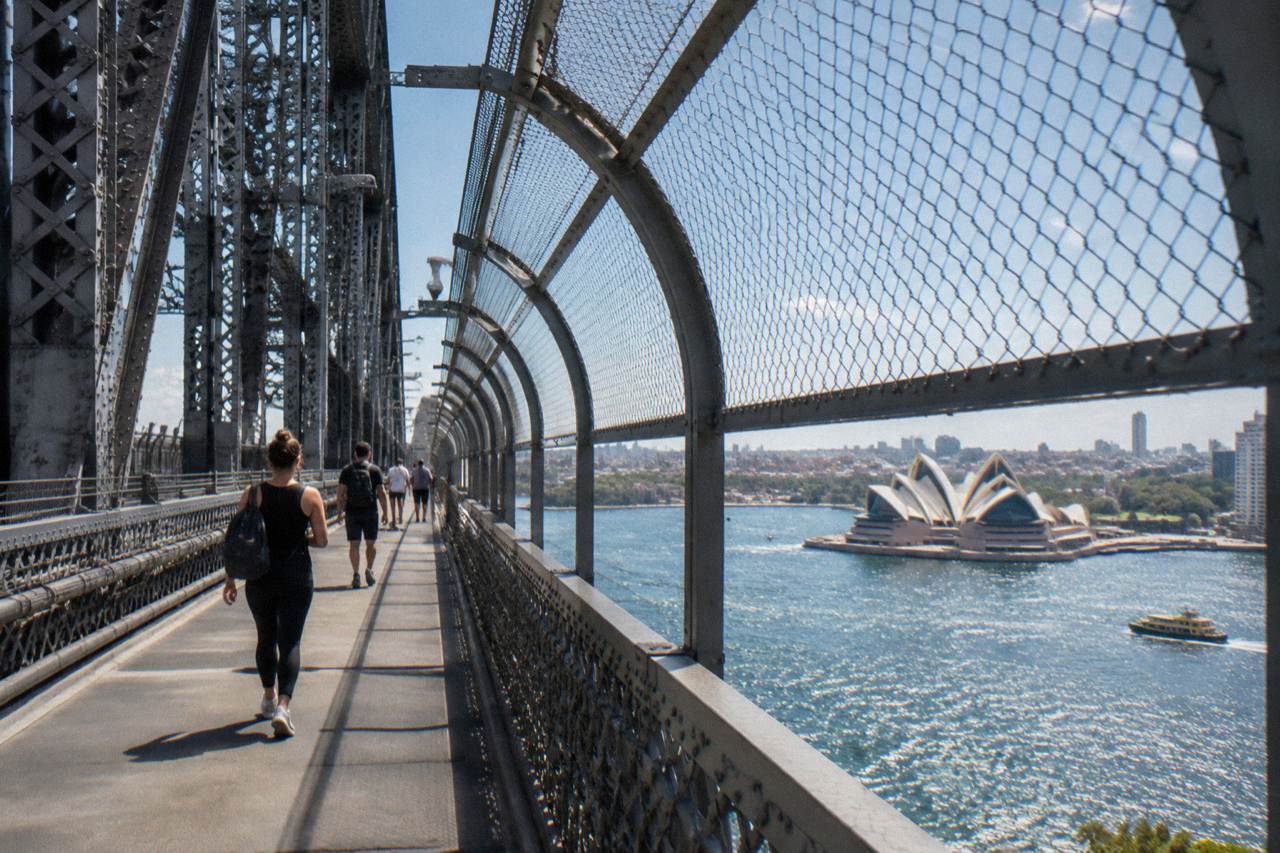
Two people can stand on the same steel arch above Sydney Harbour, one having paid nothing and the other several hundred dollars, and both would describe the same water, the same ferries, the same city laid out below them. The difference is not the view. The difference is what each of them bought. One bought a piece of public infrastructure, open every day of the year to anyone with working legs, and paid nothing because the price of a footpath is nothing. The other bought a guided experience, a suit, a harness, a trained climb leader and a photograph at the summit, and that product carries a real price, dynamic and seasonally driven, starting well beyond AUD $270 for a standard adult climb. Sydney has built one of the rare cities in the world where the single most famous structure in town can be crossed on foot for free, and the confusion between the walk and the climb is the single most common money question visitors arrive with.
This question matters because the answer gets muddled constantly, in guidebooks, in hotel lobbies and in comment threads where someone asks about the bridge and someone else answers about BridgeClimb as if the two were the same thing. They are not. The Sydney Harbour Bridge pedestrian walkway is a free public path, verified as free in this site's research pass on the NSW Government's own harbour bridge pages and recorded in the verified free-facts file that underpins every claim on this site. BridgeClimb Sydney is a separate, paid, ticketed experience operated on the same structure, priced dynamically and running at roughly AUD $270 or more for a standard adult climb, a figure sourced from the operator's own pricing communications during the 2026 research pass. The Pylon Lookout, a third thing entirely, is a small museum and viewing platform inside the bridge's southeast pylon, and it too is paid, a separate ticket once again. Three products, one bridge, three different price tags: zero, hundreds of dollars, and a modest admission fee, in that order of magnitude.
The free walk is the one this site exists to point at, and it sits inside a small, verified roster of genuinely free Sydney experiences. This directory carries 5 shipped free walking tours in total: 2 walks listed on GuruWalk and 3 walks exclusive to freetour.com, with 3 of those 5 featured with cards on this page. The bridge walkway itself is a free attraction, not a tour, so it belongs to the same category of free things as the Royal Botanic Garden, the Art Gallery of NSW's general entry and the Bondi to Coogee coastal path. The tours below are the guided layer on top of that free city: pay what you want, reserve a spot, tip the guide what the walk was worth.
How Much Does It Cost To Walk Across The Harbour Bridge?
It costs nothing to walk across the Sydney Harbour Bridge on the pedestrian walkway. Zero dollars. The footpath is a piece of public infrastructure, open around the clock to pedestrians and cyclists on their designated sides, with no gate, no ticket, no scanner and no time limit. This is the verified, sourced answer, drawn from the NSW Government's own information on the bridge. Any content claiming a fee for simply walking across the bridge, outside of specific closed or managed event days, is describing one of the paid products bolted onto the same structure, not the walk itself.
The walkway runs along the eastern side of the bridge deck. Pedestrians access it from The Rocks end via the Cumberland Street stairs or near the south pylon, and from the Milsons Point and Kirribilli side on the north. Once on the path, the crossing takes most people between fifteen and twenty-five minutes at a comfortable pace, depending on how often they stop, and stopping is the whole point. From the eastern footpath the Opera House sits framed to the southeast, Circular Quay spreads out below, the ferries cut white lines across the harbour, and Kirribilli's rooftops stack toward the north. The deck sits roughly fifty metres above the water at mid-span, high enough that the climb from the south end is genuinely felt on foot, and the steel lattice of the arch passes close overhead at the summit.
What trips people up is the vocabulary. "Walking the bridge" and "climbing the bridge" get used interchangeably in casual travel talk, and they describe two entirely different commercial realities. The walk is a footpath. The climb is BridgeClimb, a paid, guided, harnessed ascent over the outer arch of the bridge structure, well above the pedestrian deck, run by a commercial operator with dynamic pricing that starts around AUD $270 for a standard adult place and rises with peak times, summit times and package choices. The research file records the climb's pricing as dynamic, meaning no single flat number describes it, and this site will not print one. What can be stated flatly is that the climb is a paid experience and the walkway is not, and that the two share nothing except the steel.
The Pylon Lookout is the third item that causes confusion, because it sits at the pedestrian walkway's southern edge and looks, from the path, like it might be part of the free crossing. It is not. The pylon houses a small museum about the bridge's construction and a viewing gallery, and it charges admission, a separate paid ticket recorded in this site's dataset as a paid-for-the-record entry. A walker can complete the full harbour crossing, north to south or south to north, without spending anything at all, and the pylon is simply an optional paid detour off the side of the free path.
There is one more honest nuance. On rare, managed occasions, including the road closures and event days around New Year's Eve, sections of the bridge and its approaches can be subject to crowd management, closures or police direction, and no permanent free-access guarantee overrides a live event authority. The standing fact, verified and durable, is that the pedestrian walkway is a free public crossing every ordinary day of the year. That is the fact a visitor can plan around.
For a sense of scale against other big-city icons, this is unusual. Pedestrian crossings of famous bridges are often free elsewhere too, but few cities pair a free crossing of their defining landmark with a paid climbing product of such prominence on the same structure, and the marketing weight of the climb sometimes drowns out the simpler truth underneath it. Sydney's answer to the cost question splits cleanly in two: the walk costs nothing, the climb costs real money, and every visitor decides which of those two products they are actually shopping for.
The practical walkthrough of the free crossing, for anyone planning it, is short. From the south, the most common entry is via the stairs near Cumberland Street in The Rocks, which drop walkers onto the footpath within a few minutes of Circular Quay. The path rises through the approach spans, passes the southeast pylon, and then the arch itself takes over, a steady climb to the summit of the south span, the dip over the hangers at the centre, and the mirrored descent down the north span toward Milsons Point. Luna Park's face greets walkers arriving at the northern end, and Kirribilli's cafes and the harbour-side foreshore at Milsons Point sit within an easy stroll of the exit. Walkers can turn around and come back, cross and return by ferry, or loop down through Kirribilli and along the harbour's edge toward Cremorne Point, which is itself one of the free foreshore paths recorded in the verified dataset.
Time of day changes the experience without changing the price. Early morning belongs to runners and commuters, the middle of the day to tourists with cameras, and the hour around sunset to everyone who has figured out that the western sky behind the bridge turns the steel orange and the Opera House silhouettes against the water. The sunset crossing is free at exactly the same price as the 8am crossing, which is to say it costs nothing. Anyone who wants the guided version of the harbour at golden hour has a pay-what-you-want option in the Sydney Sunset Evening Tour, one of the two GuruWalk-listed walks in this site's roster, rated 4.96 out of 5 on GuruWalk across 51 reviews, though that walk covers the harbour city's evening highlights rather than the bridge deck itself.
For the data-minded, here is the verified landscape of free and paid around the bridge and the harbour, drawn entirely from this site's research files.
| Walk / attraction | Platform or type | Rating | Scale | Reviews | Meeting point or location |
|---|---|---|---|---|---|
| Best Free Tours Sydney | GuruWalk (53905) | 4.55 EN / 4.86 ES | /5 | 384 total | Wharf 6, Circular Quay |
| Sydney Sunset Evening Tour | GuruWalk (67793) | 4.96 | /5 | 51 | Queen Victoria Building, George Street |
| Sydney Rocks Free Tour | freetour.com | 9.5 | /10 | 43 | The Rocks |
| Sydney Essential Tour Part One | freetour.com | 7.2 | /10 | 24 | Jacksons on George |
| Sydney Essential Tour Part Two | freetour.com | 7.1 | /10 | 6 | Royal Botanic Garden area (monument meeting point) |
| Harbour Bridge pedestrian walkway | Free public path | No rating | n/a | n/a | Cumberland Street, The Rocks or Milsons Point |
| Bondi to Coogee coastal walk | Free public path | No rating | n/a | n/a | Bondi Beach to Coogee Beach |
| Royal Botanic Garden Sydney | Free public garden | No rating | n/a | n/a | Farm Cove, adjacent to the Opera House |
The Bondi to Coogee walk is the other great free walk in Sydney's inventory, and it makes a useful comparison for anyone weighing what to do with their walking hours. Where the bridge crossing is a twenty-minute urban traverse with steel overhead and ferries below, the Bondi to Coogee coastal walk is a roughly six-kilometre clifftop path running along the eastern beaches, from Bondi's sand through Tamarama's small cove to Bronte, Clovelly, Gordons Bay and finally Coogee. It is a free public path, verified as such in this site's research, open to anyone and requiring nothing but legs and sun sense. The two walks are almost perfectly complementary: one is vertical, industrial and harbour-facing, the other horizontal, ocean-facing and green, and a visitor with two free mornings and a pair of good shoes can do both without spending a cent on either. Sculpture by the Sea, the free outdoor exhibition staged along the Bondi-Tamarama stretch, runs 16 October to 2 November 2026 in its upcoming edition, which turns the first third of that walk into a sculpture garden for the price of nothing. The coastal walk's practical costs are entirely optional: buses at either end, a coffee somewhere, and nothing in between that a wallet is obliged to touch.
BridgeClimb Sydney deserves its own honest paragraph, because it is the product most often confused with the free walk, and because it is a genuinely good experience that simply is not what the cost question is asking about. The climb takes participants in guided groups up the outer arch of the bridge, above the roadway and well above the pedestrian walkway, in harnesses and suits, with a trained leader, a safety briefing and a summit photograph, and it is priced dynamically, running at roughly AUD $270 or more for a standard adult place per the research record, varying by time slot, season and package. The dynamic pricing means there is no single honest number, and this site declines to print a false flat one. What matters for the cost question is the separation: the climb is a paid ticketed experience on the bridge, the walkway is a free public path on the bridge, and the Pylon Lookout is a third, smaller paid museum-and-view ticket inside the southeast pylon. A visitor who wants to stand on the arch's outer spine pays hundreds; a visitor who wants to cross the harbour fifty metres above the water with the wind coming off the Tasman pays nothing. Both facts sit in this site's verified dataset side by side, because the honest answer to the cost question is that the bridge contains both a free thing and a paid thing, and they never merge.
Customs House rounds out the picture with a different kind of free, one of the city's under-visited public buildings sitting on the harbour edge at Circular Quay, a short walk from the bridge's southern approach. The building's research record carries a moderate-confidence note on its free public offerings, with the venue's general site as source, and this site's policy on that record is to describe the building honestly rather than overclaim: the ground-floor spaces and the celebrated scale model of the city in the centre of the building have a well-established reputation as free-to-view public features, though the record is flagged for re-verification against the venue's current visit page rather than published as a flat guarantee. That caution is deliberate. This site would rather tell a reader that a claim is being re-checked than send them to a closed door. What is certain is Customs House's role in a free walking day: it sits directly on the Circular Quay foreshore, between the Opera House and the bridge approach, and it anchors the free harbour-edge stroll that strings together the Opera House forecourt, the Quay itself, the Museum of Contemporary Art Australia's building on the point and the climb up into The Rocks toward the bridge's Cumberland Street stairs. Note on that museum: the MCA reintroduced paid general admission in 2025 after decades of free entry, per a Sydney Morning Herald report dated 2026-05-02, sitting at AUD $20, so it must never be listed as simply free on this site.
Free Things To Do In Sydney Nearby
The bridge walkway sits at the centre of a dense ring of free things, and the smartest free day in Sydney strings several of them together rather than treating each as a separate expedition. Start where the bridge starts, on The Rocks side, and the first free thing is The Rocks itself, its laneways and sandstone terraces, and the free Rocks Markets on their operating days. Then the Cumberland Street stairs, the walkway, the crossing, the descent into Kirribilli, and the whole northern shore opens up: Kirribilli's foreshore, the harbour-side lawns of Milsons Point, Luna Park's face to admire from the outside, and the harbour paths running east. The Cremorne Point to Kirribilli walk, a free public path in the verified dataset, traces the northern shoreline through old boatsheds and past swimming enclosures with the bridge and Opera House in view for almost the entire way. Watsons Bay and Camp Cove, at the harbour's mouth, are the far end of the same free network, reached by a ferry that is covered by the Opal card's daily fare cap of AUD $19.30 Monday to Thursday or AUD $9.65 Friday to Sunday and on public holidays, per Transport for NSW's own fares page, a transport cost rather than an attraction cost, and one worth knowing because the ferry ride past the bridge is itself one of the best views of it.
The Cremorne Point walk deserves its highlight: it is the closest thing Sydney has to a free bridge-viewing gallery, because from its western stretch the bridge appears whole, arch and deck and all, with the city towers behind it. Photographers work that stretch of path constantly and pay nothing for the privilege. The same is true of the walkway itself as a viewing platform for the Opera House, which pairs with the bridge as the other half of Sydney's two-fact icon: the Opera House's exterior and forecourt are free to wander, verified, while the guided interior tours are paid, a separate ticket on the same building. Every icon in this city seems to arrive as a two-fact case, and the habit of separating the free public half from the paid experience half will save a visitor real money across a whole trip.
For anyone who wants a guide rather than a self-directed day, the free walking tour layer is small but real: 5 shipped walks in total, 2 on GuruWalk and 3 exclusive to freetour.com, with 3 of them featured on this page. The Best Free Tours Sydney walk on GuruWalk, rated 4.55 out of 5 across 201 English-language reviews and 4.86 out of 5 across 183 Spanish-language reviews, 384 reviews in total, meets at Wharf 6 at Circular Quay, which is a five-minute stroll from the bridge's southern approach stairs, and covers the harbour's historic core on a pay-what-you-want basis. The Sydney Sunset Evening Tour, the other GuruWalk listing at 4.96 out of 5 across 51 reviews, is the evening counterpart. The Sydney Rocks Free Tour, exclusive to freetour.com and rated 9.5 out of 10 across 43 reviews on that platform's TripAdvisor-powered scale, is the deepest dive into the neighbourhood that sits at the bridge's feet. None of these walks charges a price to join; the model is a reserved free spot and a tip at the end.
The surrounding free layer extends well beyond the harbour. The Royal Botanic Garden Sydney, free for general entry and open 7am to sunset per its own pages, wraps Farm Cove immediately east of the Opera House. The Art Gallery of NSW, free for general entry with fees only on some exhibitions per its own visit page, sits on the garden's eastern edge. The Australian Museum, with general entry confirmed free on its own visit page, and the State Library of NSW, free for entry and exhibitions, sit a short walk inland. Hyde Park, the Anzac Memorial within it, the Queen Victoria Building's free-to-enter retail palazzo and NSW Parliament House's free tours on their set days round out a free city that begins, very literally, at the bottom of the bridge.
So the answer to the title question, stated once more with all its edges attached: the walk across the Sydney Harbour Bridge costs nothing on the public pedestrian walkway, every ordinary day of the year. The paid climbs on the same structure start around AUD $270 under dynamic pricing, and the Pylon Lookout is a separate modest paid ticket. The free crossing takes under half an hour without stops, longer with them, and delivers one of the most photographed harbour views on earth at a price of zero. The free things clustered around it, from the coastal walk to the Botanic Garden to the pay-what-you-want tours led by local guides, are the rest of the reason a Sydney visit can be run almost entirely on foot and almost entirely for free, with the money saved for the ferry, the coffee and, for those who want the arch's spine rather than its footpath, the climb.
For related reading on this site, see the Which Museums In Sydney Are Free? page and the Can I Go Inside Sydney Opera House For Free? page.